
One Week In
Hive 4's Growth

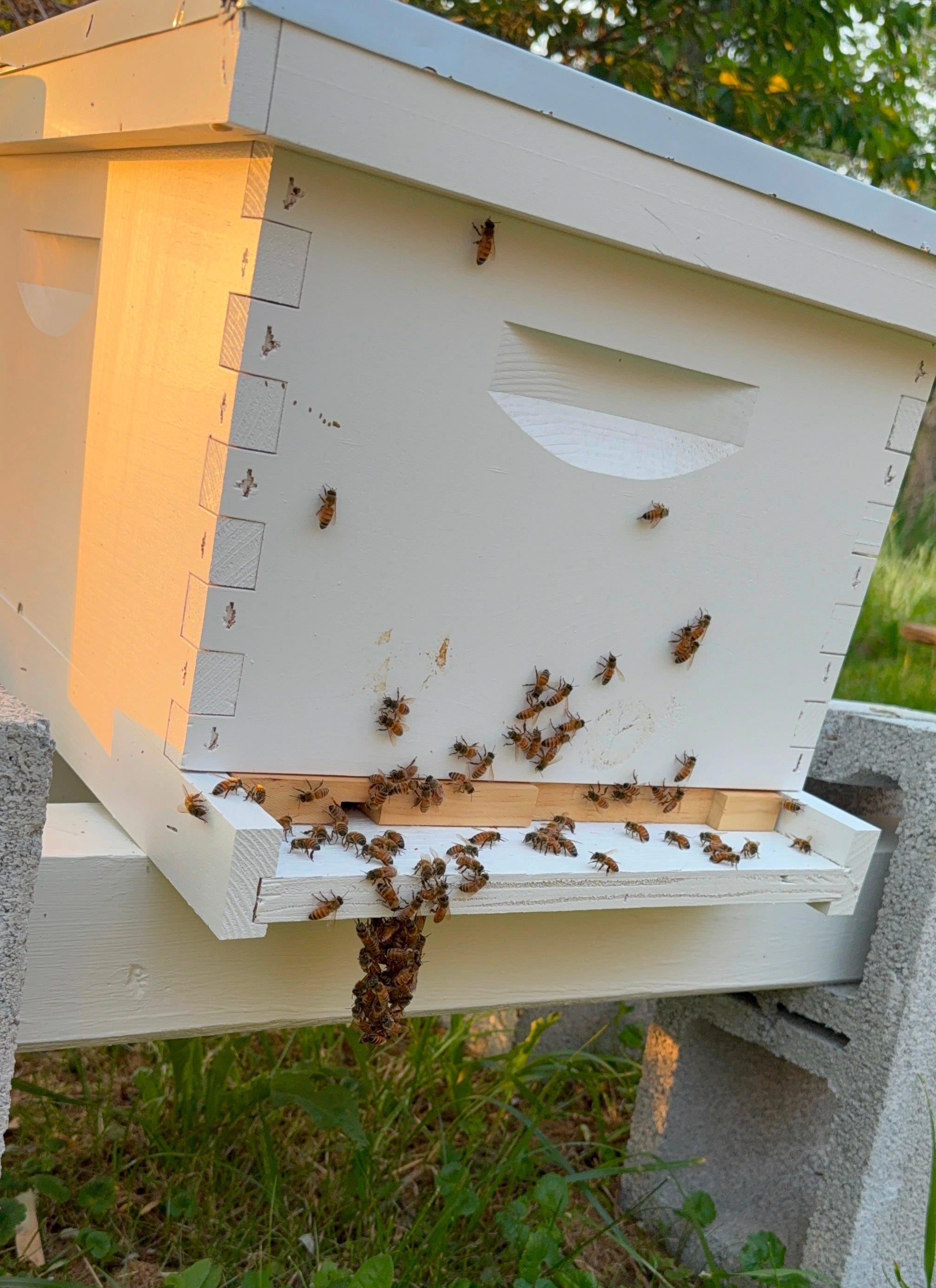
I don’t know if the conditions are perfect for exponential growth or if it’s just a bunch of bees that randomly decided to proliferate, but Hive 4 surprised the heck out of me yesterday.
On Monday, May 11th, I installed the two new bee packages I received at the Field Day sponsored by the Penn State Extension Apiary section.
Yesterday, exactly one week later, on Monday, May 18th, 2026, I checked on the state of both hives. My primary goal in making the hive inspections was to make sure each queen had extricated herself from her cage and was, hopefully, maybe even starting to lay eggs. Ideally, the bees would have accepted their queen and begun making comb in which she could lay her eggs.
I had hoped to check on the hives earlier – say, by Thursday or Friday – because if a queen isn’t out of her cage within three days or so, it’s likely she will starve to death. Nevertheless, I didn’t get the opportunity to check on the hives until Monday, as I said, even though Monday promised to be oppressively hot (in the 90s).
Consequently, I checked on both hives early in the morning yesterday (Monday) and filled both hives with 10 cups each of bee syrup. I found Hive 4 to be very active and busy, actually occupying and starting to build comb on every one of the seven frames in the hive, with only the outer half of both Frame 1 and Frame 7 still blank. This was surprising, especially compared to Hive 5, which wasn’t anywhere near as busily productive. In fact, none of the frames in Hive 5 were as busy and built up as each of the frames in Hive 4.
The hot (HOT) day unfolded and I spent most of it, among other things, tending to life and clients, trying to keep cool, and making more bee syrup to feed Hives 3, 4, and 5 once the intensity of the day’s heat subsided a bit.
I didn’t return to the hives until much later in the day – 7:30 p.m., in fact. I’d been thinking about Hive 4 all day, intrigued by how quickly the bees were filling out the brood box in the span of only a week. I was a little worried that they might explode in population and swarm. (And to be painfully honest – as you all know, or should know, I wouldn’t know a potential swarm if I fell over it. But I’d heard and read about them!)
You can imagine, then, the hitch in my breath when I rounded our barn and saw the pile of bees hanging out of the entrance of Hive 4!
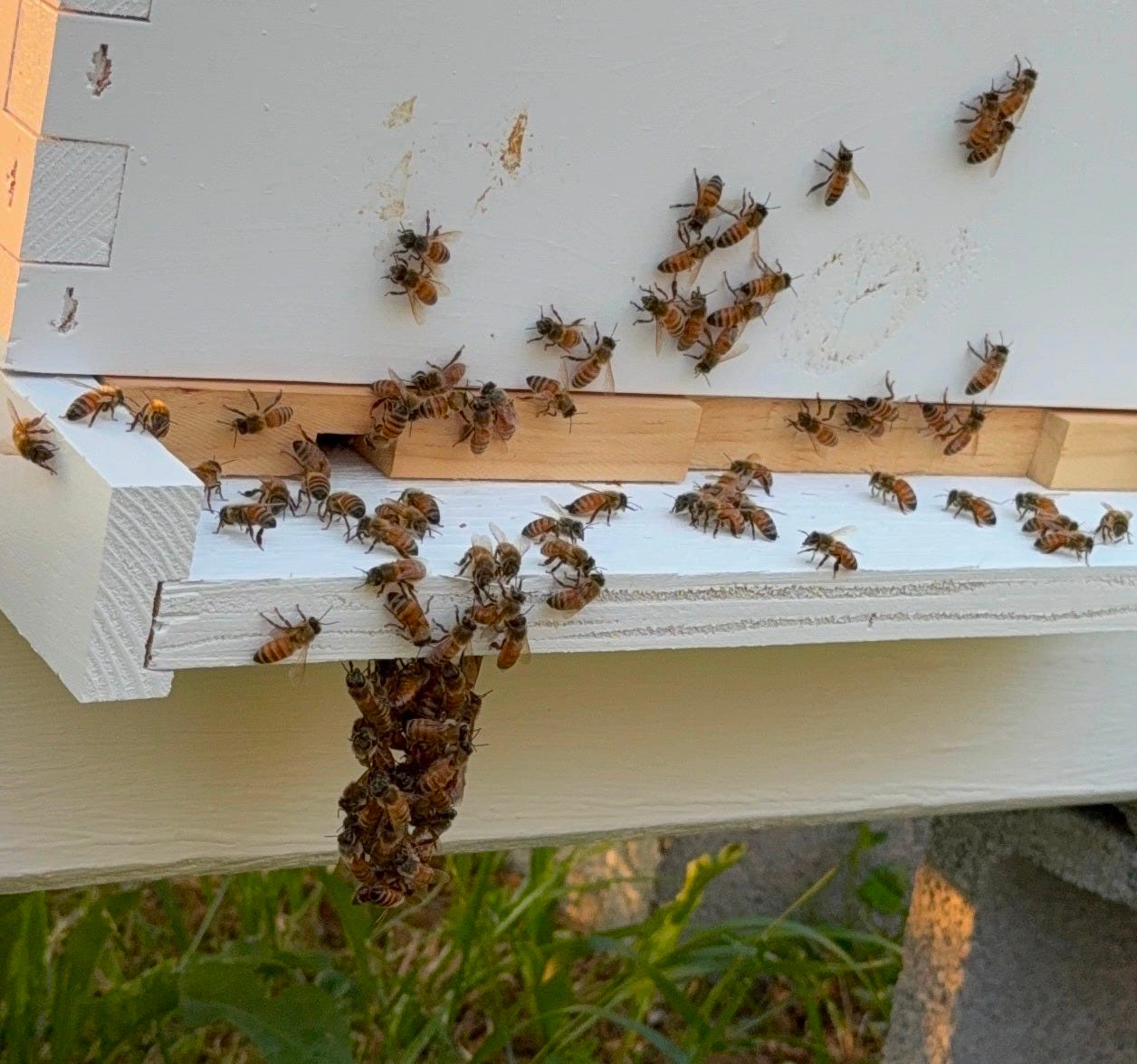
Yikes, I wondered if all the syrup I’d given them that morning had just supercharged their comb building. Along with the rest of my cohort from the Penn State study, I’d received a short video that morning and instructions on the best way to add a ‘super’ to a brood box when appropriate: namely how to take two frames with comb being built from the bottom box and adding those to the center of a new hive box to be placed on top.
With a little bit of guidance-by-text from one of my mentors, I decided to go for it and add a super to Hive 4. When I simply opened Hive 4 to remove Frames 2 and 6 (each with comb already being built) and place them in the center of the new super, I encountered a LOT of bees. I took this as a good sign that I should in fact give them ‘room to grow’ in an additional hive box.


By the time I completed this switch of frames (and I should note, when I’d checked on the hive earlier that morning, I did spot the queen on Frame 3), the bees were cranky and wanted me to get out of their hive. So I did.


When I looked at the front of the hive again, the clump of bees hanging from the entrance was gone.
I didn’t disturb any of the hives today (Tuesday). It was extra hot again (well into the 90s) and I worked all day at the polls. Tomorrow it’s supposed to go into the 90s again, but by Thursday, the heat wave is supposed to break. I’m thinking they might appreciate having another day or two to do their thing without me bugging them (even if it’s just to look and possibly add more sugar water).
Note: I’d done the same thing with Hive 1 as with Hive 4 – taking two frames with comb and putting them into the center of a new hive box placed on top of the brood box – about half an hour earlier. I was a bit more confident doing that with Hive 1, since that colony is about five weeks older than Hive 4.
Some of you may remember how hands-off I was last year. I’m being much more proactive this year than with last year’s single hive. I’m trying to find a good balance between inspecting and really giving myself a chance to look closely at (and LEARN from) what the bees are doing, and leaving them alone.
And I still need to check on Hive 2 to see whether the ‘attempted intervention’ yielded a positive result.
You are a busy bee yourself
What about hive 2? You have me sitting at the edge of my seat waiting for update.